The fix, not the score
How to get cited by AI
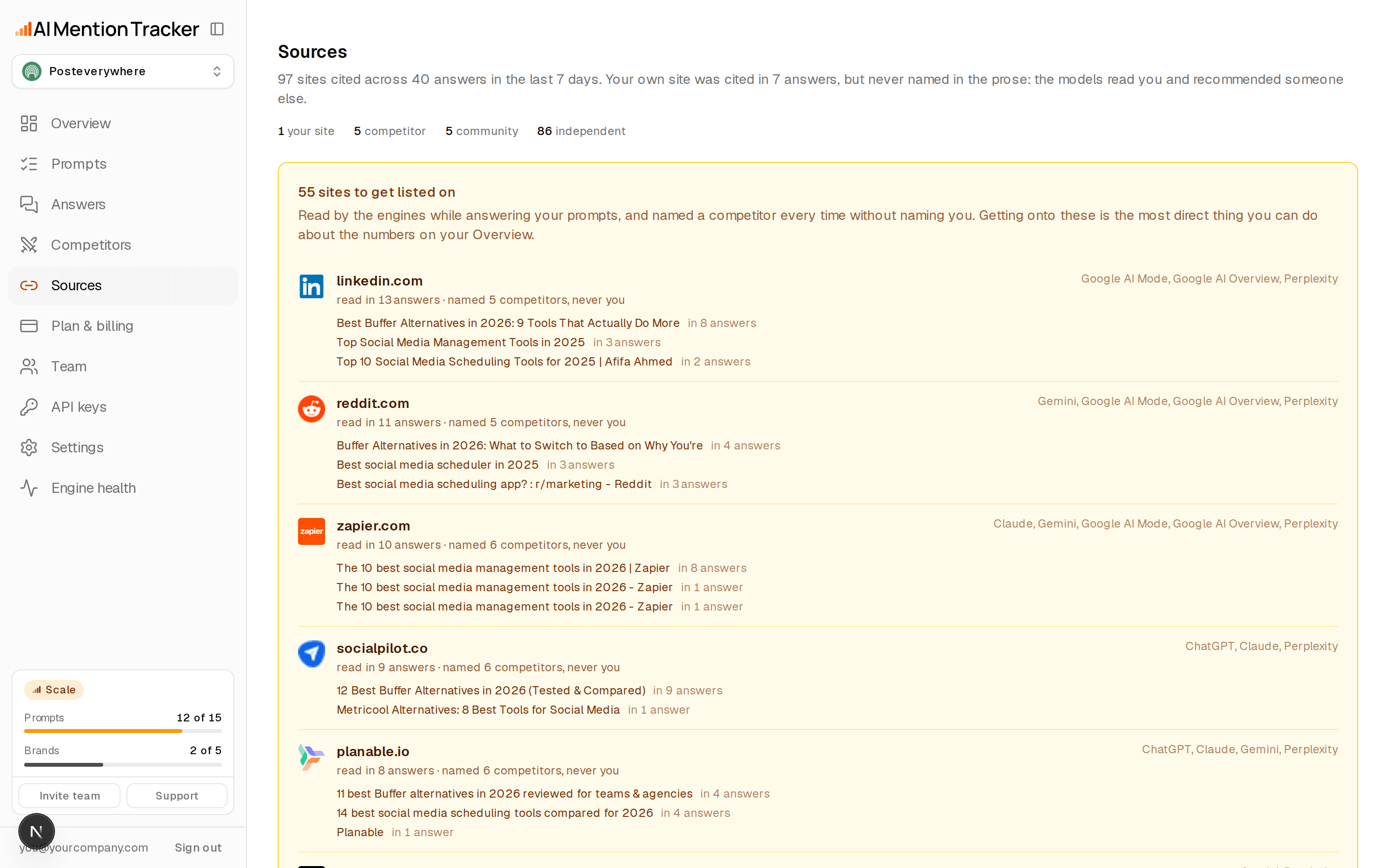
The engines already told you which pages they read. The ones that get cited again and again, name a competitor every time, and have never named you, are a to-do list with names on it.
Card required, nothing charged for 7 days
Most advice about this is unfalsifiable
Write better content. Build authority. Earn mentions. All of it is probably true and none of it tells you what to do on Monday, because none of it names a page.
There is a shortcut that most of the advice skips: when an assistant answers a question about your category, it says where it looked. The sources are in the answer. Collect enough answers and the set of pages the engines keep returning to stops being a guess and becomes a list you can count.
71 sites for one brand, and why only eight are here
These are ours. Posteverywhere is our own company, and this is its real list, filtered in public rather than quietly.
| Site the engines read | Answers citing it | Named a competitor | Named us |
|---|---|---|---|
| zapier.com | 15 | 6across 5 engines | 0 |
| socialpilot.co | 13 | 6across 3 engines | 0 |
| sintra.ai | 11 | 6across 3 engines | 0 |
| oneupapp.io | 9 | 5across 3 engines | 0 |
| postplanner.com | 9 | 5across 1 engine | 0 |
| beplan.io | 8 | 6across 3 engines | 0 |
| technologyadvice.com | 8 | 5across 4 engines | 0 |
| socialchamp.com | 7 | 6across 3 engines | 0 |
| hubspot.com | 7 | 5across 1 engine | 0 |
| techradar.com | 7 | 5across 2 engines | 0 |
| dashsocial.com | 6 | 6across 3 engines | 0 |
| napoleoncat.com | 6 | 6across 2 engines | 0 |
| loomly.com | 6 | 5across 2 engines | 0 |
| thecmo.com | 6 | 5across 2 engines | 0 |
| thenextscoop.com | 6 | 5across 1 engine | 0 |
| lyfemarketing.com | 6 | 4across 2 engines | 0 |
zapier.com was read fifteen times across five engines while assistants answered questions about our category. Sixteen of those twenty citations were one page, “The 10 best social media management tools in 2026”. It named six of our competitors and has never named us. That is not a ranking problem, and no amount of writing on our own site changes it. It is one listicle, and we are not in it.
Why the raw number is bigger than the useful one
The product reports 71 for us over seven days and 92 over thirty. Eight are in the table above. We would rather show you the subtraction than a clean list you would catch us filtering, because anyone who opens the product sees the raw one.
Platforms with no editor to contact
3User-generated content and jobs sites. The engines genuinely read them and they genuinely name competitors, but there is nobody to pitch, so they are not work a reader can do. This is the only reason anything is held back from the list below.
- linkedin.com
- reddit.com
- indeed.com
The second one is a hole in our own rule and we are fixing it. The computation drops a tracked competitor's own domain, and we track six, so every other rival's blog passes straight through. For a social media tool that means a dozen rivals writing listicles about each other, and the largest single row over thirty days is a competitor. Pitching them is not advice we would give.
And the number moves, which is the point. Our demo video says 59, and it was right on 1 October 2026. Twelve more sites qualified within a day. A count without its window and its date is not a fact, which is why both appear beside every figure here and in the product.
What to do with the list
- Start with frequency, not authority. A site cited in twenty answers about your category is worth more than a famous one cited in none. The list is already sorted by the only metric that applies.
- Read the page before you pitch it. Most of these are roundups, comparisons and integration directories. The question is usually why you are not in a list, not whether you could write a guest post.
- Check whether you are already on it and unnamed. Being present on a page the engine reads, and still not named in the answer, is a framing problem on that page rather than a coverage one. Fixing the paragraph beats publishing ten posts.
- Ignore anything a competitor owns. Their own site naming them is not a gap, and the computation already drops those.
- Re-check after the work lands. The engines have to read the page again before anything moves, and that takes weeks rather than days.
How this is computed
From stored answers, not from a crawl. Every answer we collect keeps its citation list, so a gap is a domain that appears in those citations at least twice in the window, appears alongside a competitor being named, and has never appeared alongside your own brand being named. Sites a competitor owns are excluded.
It is the Sources screen in the app, on every plan, and the same figures come back from the API as answers_citing_you_without_naming_you. If you would rather read the raw evidence, we wrote up what cited-but-not-named means and why it needs the opposite work to being absent.
Questions about getting cited
Answered from what the product computes.
How do you get cited by AI?
Is this the same as link building?
Why does being cited matter if I am not named?
How many of these sites are there usually?
Can I see this for my own brand?
7-day trial
Get your own list
Add your brand and the prompts your buyers type. The sites the engines read appear as the answers come in, from $9 a month with all six engines on every plan.
Card required, nothing charged for 7 days.
On every plan
- Every answer stored in full, with its citations.
- Every rate shown with the number of checks behind it.
- Cited-but-not-named reported as its own state.