Developer docs
The AIMentionTracker API, CLI and MCP server
Read your brand's AI visibility from code: how often each assistant names you, the answers behind every number, and which sources those engines read first. Six read-only endpoints, one header, no SDK required.
Card required, nothing charged for 7 days
What you get from the AI visibility API
One API. Three ways to reach it.
Everything runs on a read-only REST API at https://app.aimentiontracker.ai/api/v1, authenticated with an organisation key you mint at API keys in the app.
The CLI and the MCP server are conveniences over that same API. Neither can do anything the API cannot, and all three obey the same rules below.
curl -H "X-API-Key: $AMT_API_KEY" \
  https://app.aimentiontracker.ai/api/v1/me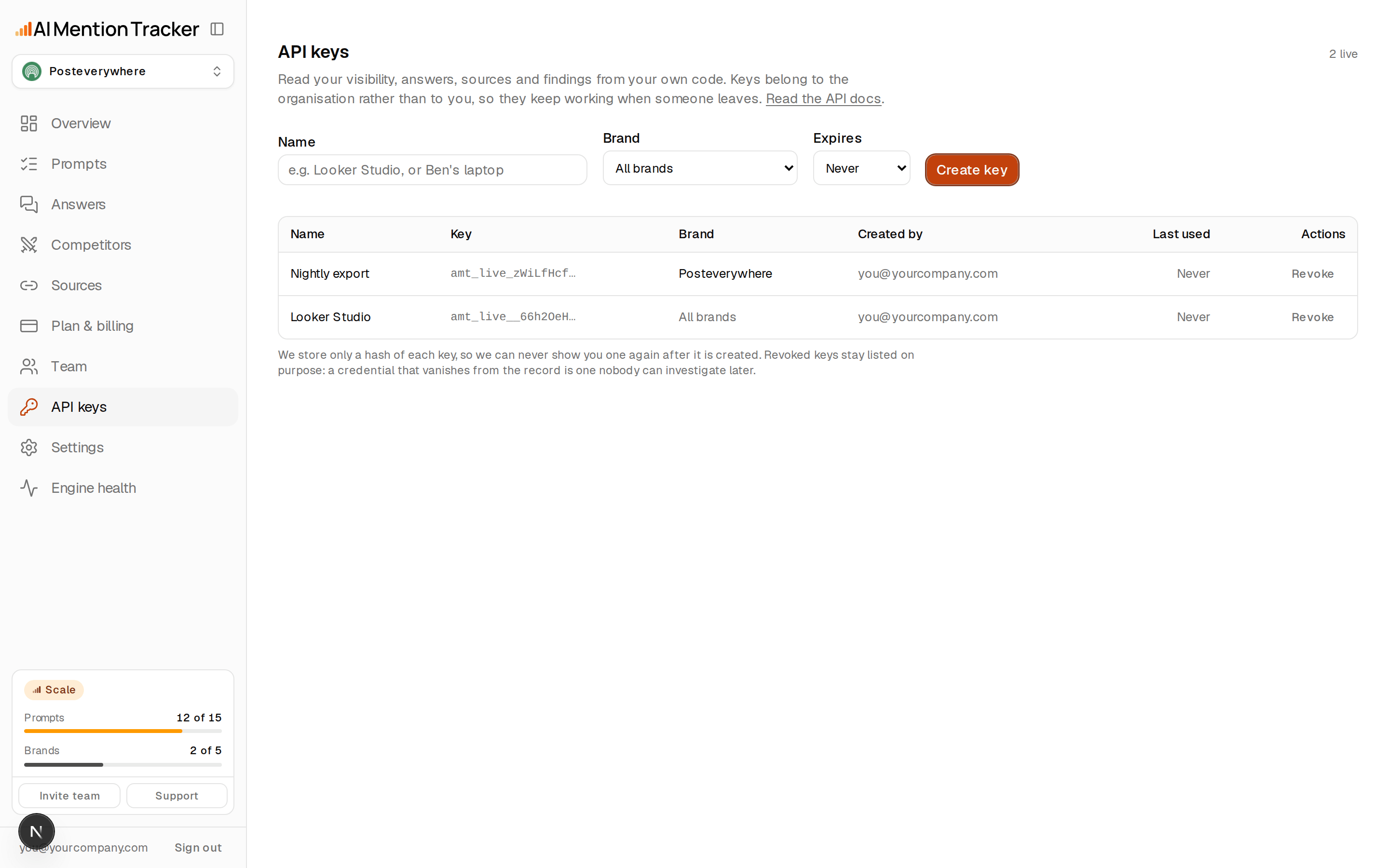
Read these before you render a number
We sell measurement honesty, so the API is opinionated about how its output may be presented. A client that ignores the three rules below will produce a report that is confidently wrong, in your customer's name, and it will look fine until somebody checks it.
Three rules you must not break
These are not style preferences. Breaking them produces a confidently wrong report in your customer's name.
- 1
A null rate means "not enough answers yet". It is NOT zero.
Rates come back as {present, responses, rate, min_sample}. When rate is null, the sample is below the floor. Say “3 of 4 answers, too few to quote a percentage”. Never render it as 0%, and never let it into an average. Reporting “0% visibility” for a brand that was named in 3 of 4 answers is the single most damaging thing you can do with this data.
- 2
Never average the engines.
There is no single visibility score and you must not compute one. ChatGPT, Perplexity and Google AI Overviews are different surfaces that disagree, so a mean describes nothing real. Report per engine. If the user insists on one number, give them the pooled counts (present and responses summed) and say plainly what you did.
- 3
An empty alerts list does NOT mean nothing changed.
A finding is raised only when both comparison windows carry enough answers AND the move is larger than its own margin of error. On a small plan that excludes most real movement. Say “no change large enough to distinguish from noise at this sample size”. GET /me shows the thresholds in force.
The long version, including why a failed collection on our side never counts as your brand being absent, is on how to read our numbers.
The six endpoints
All GET. All read-only. The full reference has parameters and returned fields.
/me
Who this key is, and the rules for reading the numbers
/brands
Every brand this key may read
/visibility
Presence per engine and per brand over a trailing window
/answers
The stored answers, with their mentions and citations
/sources
The domains the engines read before answering
/alerts
Findings about your brand, newest first
Every page in these docs
Quickstart
Mint a key, call /me, make a first real request. Five minutes.
API reference
All six endpoints, their parameters, every returned field and a worked response.
Errors and rate limits
Ten error codes, what each one means, and the headers on every response.
Multiple brands
Why omitting ?brand= is an error rather than a default, and how pinned keys work.
CLI
Nine commands, JSON when piped, tables when watched, zero dependencies.
MCP server
Six read-only tools, hosted or local, holding none of your secrets.
Reading the numbers
The three rules in full, and why a failed collection is never your absence.
Common questions about the API
Answered from the implementation.
Does AIMentionTracker have an API?
Is the AIMentionTracker API read-only?
How do I get an API key?
What is the rate limit on the AIMentionTracker API?
Does AIMentionTracker have an MCP server?
Which language should I use?
7-day trial
Measure it first, automate it second
The API reads what we have already collected. Add your brand and the prompts your buyers type, and the first answers are readable within minutes.
Card required, nothing charged for 7 days.
On every plan
- Every answer stored in full, with its citations.
- Every rate shown with the number of checks behind it.
- Cited-but-not-named reported as its own state.