
Most advice on ranking in AI Overviews describes a lever that Google says does not exist. There is no AEO schema, no Overview-specific markup, and no separate ranking system sitting beside Search.
What there is instead: a narrow eligibility gate that quietly disqualifies pages, a retrieval mechanism that matches you against questions nobody typed, and an outcome that splits into states most tools flatten into one number.
There is no AI Overview lever
Google's guidance for site owners is unusually direct about this. Structured data, it says, isn't required for generative AI search, and there's no special schema.org markup you need to add. Keep using schema for rich results, but not as an Overview strategy.
The same document places generative features inside the existing system rather than beside it: they are "rooted in our core Search ranking and quality systems", assembling answers from the Search index using retrieval-augmented generation. So the honest version of "how to rank in AI Overviews" starts with being retrievable in ordinary Search, which is unglamorous and is also what the evidence supports.
That does not make the question pointless. It relocates it: the work is ordinary, the measurement is not, which is the distinction our methodology is built around.
The eligibility gate nobody checks
Before ranking is even a question, there is a binary one. To appear in generative features a page must be indexed and eligible to be shown in Search with a snippet.
That single word does more damage than most audits catch. Google notes that nosnippet, data-nosnippet, max-snippet and noindex set your display preferences, and more restrictive permissions will limit how your content is featured in its AI experiences.
So a max-snippet:0 left over from a scraping worry, or a data-nosnippet
wrapped around the paragraph that actually answers the question, removes you
from Overviews while leaving your blue-link ranking untouched. Nothing in a
rank tracker will show it. Check these first, because no amount of content
work survives them.
Query fan-out: you are answering questions nobody asked
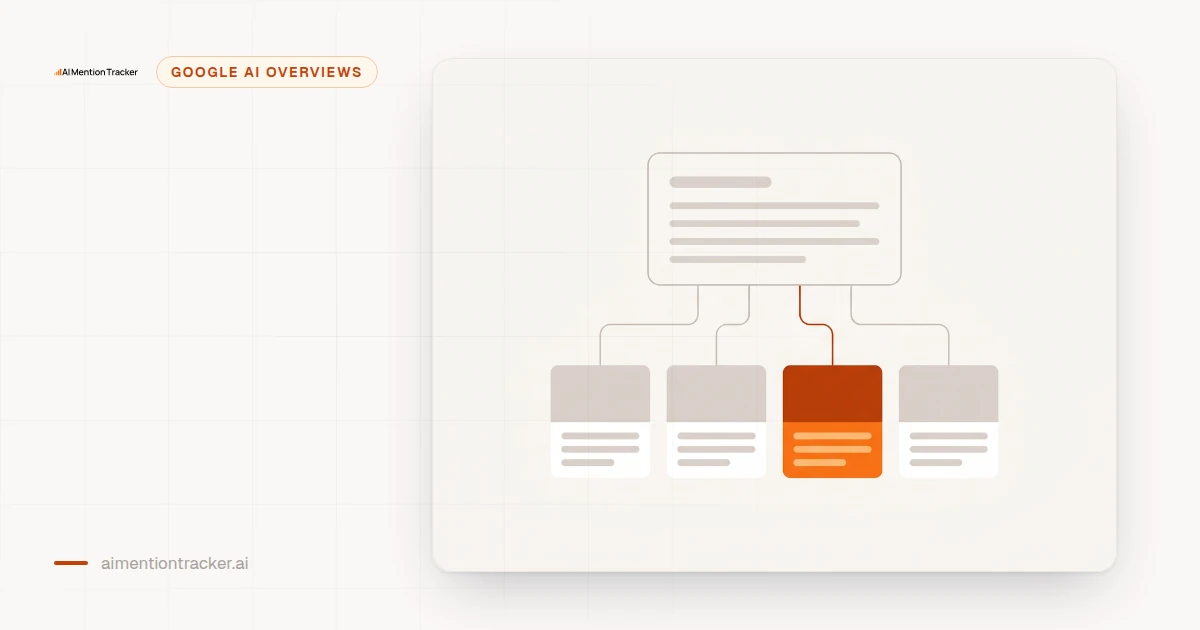
The mechanism worth understanding is query fan-out: a set of concurrent, related queries the model generates alongside the typed one, fetching results for all of them to assemble a single answer.
The consequence is counter-intuitive. You are not competing for one query. You are competing for a spray of related ones you never see, and a page that answers a narrow question thoroughly can be pulled into an Overview for an adjacent question it never targeted.
This is why picking the questions you track matters more than it looks, and why we price prompt suggestions against real search volume rather than letting a team guess — choosing the set is the decision every downstream number inherits.
Four outcomes, not one ranking
"Ranking" in an Overview is not a position. Each check lands in one of four states, and they imply different work:
- No Overview shown. Nothing to win on that query yet. It belongs outside your denominator, not counted as a loss.
- Shown, you are absent. The real gap.
- Cited, not named. Your page is in the sources, a competitor is in the sentence. You have the retrieval and not the framing.
- Named. Your brand is in the prose a reader actually reads.
The third is the one that changes what you do. Being cited without being named means Google found you, judged you relevant and linked you — and still described someone else as the answer. Writing three more articles does not fix it, because coverage was never the problem.
The three things people do instead, and why they do not work
Almost every "AEO checklist" reduces to one of three moves. Each is either explicitly contradicted by Google's documentation or unsupported by anything measurable.
Adding schema to chase Overviews. Covered above: Google says no special markup is needed. Its structured data guidance is about eligibility for rich results, which is a different surface with its own requirements. Worth doing. Not this.
Google does attach one condition to schema that is easy to get wrong: structured data must match the visible content. Markup describing a price, rating or author the page does not show is a quality problem rather than a shortcut, and the penalty for getting it wrong is larger than the upside of getting it right.
Writing "answer-first" paragraphs everywhere. There is a real idea buried here — retrieval operates on passages, so a claim stated plainly is easier to lift than the same claim spread over a table and three subheadings. But rewriting an entire site into question-and-answer format optimises for a mechanism nobody outside Google has measured, and it usually makes the page worse to read. The version worth keeping is narrow: say the thing, in a sentence, near where it is asked.
Publishing more. Volume is the reflex when a brand finds it is absent, and it is the wrong response to the most common finding. If you are cited but not named, Google already retrieved you; the gap is how your category gets described, not how much you have written about it. More posts change the number of documents, not the framing — which is why we report how you are described as its own measurement rather than folding it into a mention count.
What actually moves it
Google's own ordering is worth repeating, because it is duller and more honest than most alternatives: creating content people find unique, compelling and useful "will likely influence your website's presence in generative AI search in the long run more than any of the other suggestions in this guide."
Beneath that, in rough order of how often we see it matter:
- Fix snippet eligibility. Binary, and invisible to rank tracking.
- Answer the question in the page, in plain sentences. Retrieval works on passages; a claim buried in a comparison table is harder to lift than the same claim written as a sentence.
- Work on the pages that already brief your category. In most categories the heavily cited domains are review sites, comparison posts and forums rather than vendor sites. Being accurately described there beats another post on your own blog.
- Watch the framing, not just the mention. An Overview can name you as the expensive option, and that is a content problem upstream of Google.
How to tell whether any of it worked
This is where most AI Overview advice quietly stops, and it is the part we can speak to with data rather than opinion.
An Overview is generated at the moment of the search, so two checks minutes apart can name different brands with nothing having changed. A before-and-after screenshot is not evidence. What you need is a rate across repeated checks with the number of checks attached, and roughly two weeks before reading a direction into anything.
It also means an Overview being inconsistent is not the same as it being wrong — a distinction worth its own piece, which is whether AI Overviews are accurate.
The mechanics of setting that measurement up are in how to track Google AI Overviews, and our AI Overview tracker runs it on a fixed schedule, reporting the four states separately rather than averaging them into a score.